Why is Río Celeste blue when the two streams that feed it appear almost colorless? The answer lies in an unusual combination of water chemistry, microscopic particles, and sunlight. This natural phenomenon occurs inside Tenorio Volcano National Park, in northern Costa Rica, where the river changes appearance at a place called Los Teñideros.
At first glance, the turquoise water looks almost artificial. However, no dye is involved. Scientists have studied the river and identified a process that combines chemistry, biology, and the scattering of light.
Understanding that process makes a visit more interesting. It also explains why Río Celeste sometimes looks bright blue, while heavy rainfall can leave the same river looking cloudy or brown.
Why Is Río Celeste Blue? The Scientific Explanation
Río Celeste gets its distinctive color from tiny suspended particles that scatter sunlight.
These particles contain aluminum, silicon, oxygen, and related chemical components. Scientists describe them as hydroxyaluminosilicate colloids.
Although that name sounds complicated, the basic principle is straightforward. The particles are small enough to remain suspended in the flowing water. When sunlight reaches them, they scatter light in a way that produces the river’s unusual blue appearance.
The particles themselves are not bright blue pigments. Instead, the color is an optical effect created by their interaction with light.
What Are Aluminosilicate Particles?
Aluminosilicates are materials containing aluminum and silicon linked with oxygen.
In Río Celeste, researchers have identified extremely small suspended particles with an aluminosilicate composition. Their size and concentration help determine how the river interacts with incoming light.
Scientists refer to these suspended materials as colloids. Unlike large pieces of sediment that settle quickly, colloidal particles can remain dispersed in water.
As a result, they influence how light travels through the river.
How Does Light Scattering Make Water Look Blue?
Sunlight contains different wavelengths that our eyes perceive as different colors.
When light encounters particles suspended in water, some of it changes direction. This process is called light scattering.
Researchers studying Río Celeste identified a form known as Mie scattering. It occurs when light interacts with particles whose sizes are comparable to the wavelengths of visible light.
The combined effect produces the river’s distinctive appearance.
Importantly, the water does not need to contain a dissolved blue chemical for this to happen.
Is Río Celeste Really Blue?
Yes, the blue appearance is a real natural phenomenon.
However, it does not mean that every sample of river water would look turquoise in a transparent glass.
The visible color depends on suspended particles, light, water depth, and viewing conditions. Therefore, the river can look different in photographs taken at different times.
Its appearance is not simply a reflection of the sky.
Los Teñideros: Where Río Celeste Changes Color
Los Teñideros is the most important location for understanding Río Celeste’s unusual color.
Here, two streams meet:
- Río Buenavista, which has relatively neutral water.
- Quebrada Agria, which has more acidic water.
Before the confluence, both streams appear comparatively clear. After they mix, the river develops its recognizable turquoise color.
The difference comes from their chemical characteristics.
What Happens When the Two Streams Meet?
Quebrada Agria carries acidic water containing dissolved substances, including aluminum and silicon compounds.
Río Buenavista has different chemical properties. When the waters mix, the overall acidity changes.
These conditions favor the formation of suspended hydroxyaluminosilicate particles.
The particles then scatter sunlight, creating the river’s blue appearance.
In simple terms, the process involves three connected stages: the streams mix, particles form, and those particles scatter light.
However, research has also shown that microorganisms help create the chemical conditions needed for the process.
Why Is the Color Change So Visible?
Los Teñideros allows visitors to observe the transition between the incoming streams and the river downstream.
The contrast can be striking because the suspended particles become important to the river’s appearance after the waters mix.
Nevertheless, the effect is not equally visible every day.
Rainfall, sediment, sunlight, and water flow can change what visitors see.
What Scientific Research Says About Río Celeste
Scientists have investigated Río Celeste to understand why its color differs from that of its tributaries.
Two studies are particularly important because they explain both the optical effect and the formation of the suspended particles.
The Earlier Particle-Aggregation Explanation
In 2013, researchers published a study in PLOS ONE examining Río Celeste’s water chemistry and optical properties.
They concluded that the river’s color came from light scattering by suspended aluminosilicate particles.
Their measurements supported the role of Mie scattering rather than dissolved blue-colored substances.
At the time, the researchers proposed that smaller particles already present in Río Buenavista joined together when the stream mixed with acidic Quebrada Agria.
According to this explanation, the resulting larger particles scattered light and produced the blue color.
The study established an important foundation, although the proposed particle-formation mechanism was later revised.
What Later Research Clarified
A study published in Environmental Microbiome in 2023 investigated the chemical and biological processes more closely.
The researchers found evidence that the particles form through chemical precipitation when acidic Quebrada Agria is partially neutralized by Río Buenavista.
This finding challenged the earlier idea that the particles mainly resulted from smaller particles joining together.
The newer research also identified an important role for microorganisms.
Sulfur-oxidizing bacteria in Quebrada Agria help create acidic conditions. Those conditions encourage the release of aluminum and other substances into the water.
Meanwhile, diatoms in Río Buenavista influence how silicon occurs in the stream. Their activity may help create conditions favorable for particle formation.
The blue river therefore results from several connected processes rather than a single isolated reaction.
Read the updated study: Out of the Blue: The Independent Activity of Sulfur-Oxidizers and Diatoms Mediate the Sudden Color Shift of a Tropical River.
What Scientists Agree On
Both studies support the central role of suspended aluminosilicate particles and light scattering.
The major refinement concerns how those particles form.
This distinction matters because it provides a more accurate explanation than the familiar statement that two rivers simply mix and turn blue.
Is Río Celeste Blue Because of Volcanic Activity?
Tenorio Volcano provides an important geological setting for the river.
Volcanic and geothermal environments can influence groundwater chemistry, mineral availability, and the acidity of nearby streams.
However, Río Celeste is not blue because lava or volcanic ash directly colors the water.
Instead, geological conditions contribute to the chemical environment in which the suspended particles form.
Does Sulfur Make Río Celeste Blue?
Not directly.
Sulfur-related processes influence the chemistry of Quebrada Agria. In particular, sulfur-oxidizing bacteria contribute to the stream’s acidity.
That acidity helps mobilize substances involved in particle formation.
Nevertheless, sulfur is not a blue pigment that simply dissolves into the river.
Is Río Celeste a Hot River?
The blue appearance does not mean that the entire river is hot.
Tenorio Volcano National Park contains geothermal features, including Borbollones, where gases escape through the water.
These features reflect the region’s volcanic setting, but they should not be confused with the optical explanation for the river’s color.
Visitors must observe geothermal areas from authorized locations.
Why Does Río Celeste Sometimes Turn Brown?
Heavy rainfall can temporarily change Río Celeste’s appearance.
Rain washes soil and other material into rivers and streams. This increases suspended sediment and reduces water clarity.
When additional particles cloud the water, they can obscure the optical effect responsible for the turquoise color.
As a result, the river may look brown, gray, or less intensely blue.
Does Rain Always Make Río Celeste Lose Its Color?
No. Light rain does not necessarily produce a dramatic change.
The effect depends on rainfall intensity, upstream conditions, river flow, and the amount of sediment entering the water.
Therefore, a rainy morning does not automatically mean visitors will miss the blue color.
How Long Does the Blue Color Take to Return?
There is no reliable universal recovery time.
Conditions depend on how quickly sediment levels decline and whether additional rainfall occurs upstream.
The river may regain its distinctive appearance as the water becomes clearer. However, travelers should avoid expecting the color to return within a fixed number of hours.
Can Río Celeste Look Green or Gray?
Yes. The perceived color can vary with sediment, lighting, water depth, and viewing angle.
Turquoise water may appear greener under some conditions or duller when the river becomes cloudy.
These changes do not necessarily mean the underlying particle-forming process has stopped.
Does the Time of Day Affect Río Celeste’s Color?
Sunlight influences how visitors perceive the river.
Direct light can make the turquoise appearance more noticeable. Meanwhile, rainforest shade and cloud cover may reduce contrast.
However, the river does not become blue only when the sun is shining directly overhead.
The suspended particles remain part of the system even when lighting changes.
For photographers, the most important factors are water clarity, available light, and a safe viewing position.
There is no single hour that guarantees the brightest photographs.
Best Time to See Río Celeste’s Turquoise Water
The best conditions generally involve relatively clear water and manageable hiking weather.
However, the Bijagua and Tenorio region receives substantial rainfall throughout the year.
Accordingly, Costa Rica’s usual Pacific-coast dry-season descriptions do not perfectly represent the national park.
Relatively Drier Conditions
Periods with less rainfall may reduce sediment runoff and improve trail conditions.
Nevertheless, showers can occur even during comparatively drier months.
Rainier Conditions
Rain supports the surrounding rainforest but can make trails muddy and affect river clarity.
Heavy downpours may also lead park authorities to restrict access for safety.
Can You Predict the Color Before Visiting?
Not with certainty.
Weather forecasts can indicate possible rainfall, but they cannot guarantee the river’s appearance.
Check recent local conditions and official park information before traveling. More importantly, plan to appreciate the forest and volcanic landscape even if the water is not intensely blue.
Is Río Celeste’s Blue Water Safe to Swim In?
The river’s color does not establish whether its water is safe for swimming or drinking.
A natural optical effect should not be confused with a water-quality assessment.
More importantly, swimming and entering the river are prohibited inside Tenorio Volcano National Park.
These restrictions apply regardless of whether the water appears clear, blue, or brown.
Where Can You See Río Celeste’s Blue Color?
Several viewpoints along the park’s main trail provide opportunities to observe the river.
Río Celeste Waterfall
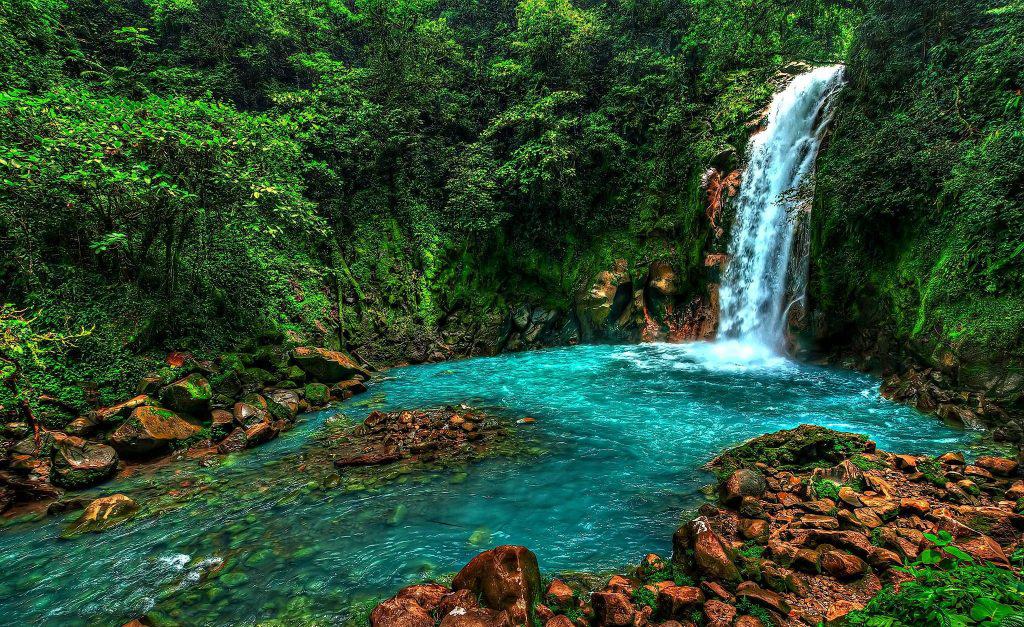
The waterfall is the best-known viewpoint. Its turquoise pool creates a striking contrast with the surrounding rainforest when conditions are favorable.
However, the pool’s color may change after heavy rain.
Laguna Azul
Laguna Azul is a calmer section of the river where visitors can observe the water from the designated trail.
Its appearance also depends on clarity and light.
Los Teñideros
For travelers interested in the scientific explanation, Los Teñideros is particularly important.
This is where the two streams meet and the color-producing phenomenon becomes visible.
Other Sections of the River
The river continues beyond the main visitor attractions.
However, visitors should not leave designated trails or enter restricted areas to search for alternative viewpoints.
How to Visit Los Teñideros and Río Celeste
Río Celeste’s principal attractions are reached through Tenorio Volcano National Park.
The main trail, Misterios del Tenorio, is approximately 6 kilometers round trip. It includes forest paths, uneven terrain, and a staircase leading to the waterfall viewpoint.
SINAC lists park admission from 8:00 a.m. to 2:00 p.m., with visitors required to leave by 4:00 p.m. Tickets are purchased through its official online system.
Check current requirements before visiting, since access and operating conditions may change.
Common Myths About Río Celeste’s Blue Water
Several popular explanations overlook the science.
Myth: The river is artificially dyed. The color is natural and results from suspended particles scattering sunlight.
Myth: The river is blue because it reflects the sky. Sky reflections can influence how water looks, but they do not explain Río Celeste’s distinctive color.
Myth: Sulfur directly makes the river blue. Sulfur-related biological processes affect water chemistry, but sulfur is not the blue pigment.
Myth: Río Celeste is always turquoise. Rainfall and sediment can temporarily change its appearance.
Myth: Volcanic lava makes the water blue. The explanation involves water chemistry, particle formation, and light scattering, not lava entering the river.
Myth: Brown water means the natural phenomenon has stopped. Sediment may simply be obscuring the characteristic color.
Why Río Celeste Matters for Science and Conservation
Río Celeste demonstrates how geology, microorganisms, chemistry, and light can interact in a natural environment.
Its unusual appearance has encouraged scientific research into water chemistry and environmental microbiology.
However, the national park protects much more than a colorful river. Its rainforest, watersheds, and wildlife habitats are also important.
Visitors can help protect these resources by remaining on designated trails, respecting swimming restrictions, and avoiding litter.
Frequently Asked Questions About Why Río Celeste Is Blue
Why is Río Celeste blue?
Tiny suspended hydroxyaluminosilicate particles scatter sunlight, producing the river’s turquoise appearance.
What makes Río Celeste turquoise?
The combination of water chemistry, particle formation, and light scattering creates the color.
Is Río Celeste naturally blue?
Yes. Its appearance results from natural physical, chemical, and biological processes.
Is the river artificially colored?
No. Scientific studies have identified the natural mechanisms responsible.
What happens at Los Teñideros?
Two streams with different chemical characteristics mix, creating conditions that form light-scattering particles.
Which streams meet there?
Río Buenavista and Quebrada Agria.
What are aluminosilicate particles?
They are tiny suspended materials containing aluminum, silicon, and oxygen-related components.
Does sulfur make Río Celeste blue?
Not directly. Sulfur-oxidizing bacteria help create chemical conditions involved in particle formation.
Is the color caused by Tenorio Volcano?
The volcanic environment influences the water chemistry, but the blue appearance results from suspended particles scattering light.
Why does Río Celeste turn brown after rain?
Rainfall can increase sediment and reduce water clarity, temporarily obscuring the turquoise appearance.
Does Río Celeste stay blue all year?
The natural process continues, but the visible color varies with conditions.
Can Río Celeste look green?
Yes. Lighting, sediment, and water clarity can affect the perceived color.
Does sunlight affect the color?
Yes. Light is essential to the visible optical effect, although direct sunshine is not always necessary.
Is the blue color a reflection of the sky?
No. The distinctive coloration is primarily associated with suspended particles scattering light.
Can you swim in Río Celeste?
Swimming is prohibited inside Tenorio Volcano National Park.
Is Río Celeste water safe to drink?
Do not drink untreated river water. Its appearance does not establish its safety.
Where is the best place to understand the color change?
Los Teñideros, where the two streams meet.
What is the best time to visit?
Relatively clear-water conditions are ideal, but no season guarantees turquoise water.
Is Río Celeste’s color a chemical reaction?
Chemical processes help form the suspended particles, while light scattering produces the visible blue appearance.
Is Río Celeste the only blue river in Costa Rica?
No. Other waters can appear blue or turquoise, although Río Celeste is particularly well known for its documented confluence phenomenon.
Final Thoughts: Why Is Río Celeste Blue?
The answer to why is Río Celeste blue involves more than an unusual mineral or a reflection of the sky.
At Los Teñideros, waters with different chemical characteristics mix. This creates conditions that form tiny hydroxyaluminosilicate particles. Those particles scatter sunlight, producing the river’s recognizable turquoise appearance.
Scientific research has also shown that microorganisms contribute to the chemistry behind the process.
Although rainfall can temporarily obscure the color, Río Celeste remains an important example of the relationship between geology, biology, and natural optical effects.
Understanding that relationship adds another dimension to visiting Tenorio Volcano National Park and reinforces why its waterways deserve protection.
Related Posts
Río Celeste for Families: What Parents Should Know
Río Celeste for families can be a rewarding experience, especially…
Day Trip to Río Celeste from La Fortuna: Is It Worth It?
A day trip to Río Celeste from La Fortuna is worth considering if you enjoy hiking and have a full day available. The journey takes you away from the Arenal area into the rainforest surrounding Tenorio Volcano National Park, where a turquoise river, waterfall, and volcanic features create a different experience from La Fortuna's more accessible attractions. However, this is not a quick waterfall stop. You should allow roughly three to four hours for round-trip driving, several hours for hiking, and additional time for parking and lunch. Heavy rainfall can also affect the river's famous blue color. For travelers with limited time, mobility concerns, or plans to swim, staying closer to La Fortuna may be the better choice. But if Río Celeste is high on your Costa Rica itinerary, a well-planned day trip is entirely reasonable. Day Trip to Río Celeste from La Fortuna: Quick Verdict Planning detailWhat to expectDriving distanceApproximately 65–80 km each way, depending on the routeDriving timeAround 1.5–2 hours each wayRound-trip drivingApproximately 3–4 hoursFull park hikeApproximately 6 km round tripTypical hiking timeAround 3 hoursTotal excursionAllow approximately 8–10 hoursMain entranceEl Pilón sector, near BijaguaSwimmingProhibited inside the national parkParkingPrivate parking near the entrance, charged separatelyRecommended departureAround 6:30–7:00 a.m.Best forHikers, nature enthusiasts, and travelers with a full day The driving figures are planning estimates rather than live navigation times. Trail length and park regulations should be checked against current SINAC information before departure. The verdict: Río Celeste is worth the journey if the rainforest hike is part of the attraction for you. If you only want to see a waterfall without spending most of the day traveling, La Fortuna Waterfall is more convenient. How Far Is Río Celeste from La Fortuna? The drive from central La Fortuna to the main entrance of Tenorio Volcano National Park is commonly estimated at approximately 65–80 kilometers. The exact distance depends on your starting point and the roads selected.…
Can You Swim in Río Celeste?
Can you swim in Río Celeste? Not inside Tenorio Volcano National…